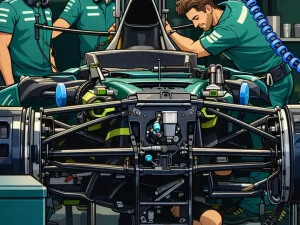
McLaren didn’t arrive in 2026 as a team in crisis, but it has spent the first half of the season looking like one that’s permanently a step late to the punch.
The reigning Constructors’ champions are already 154 points adrift of Mercedes in the standings, and the worrying part for Woking is the shape of the deficit as much as the size of it. Ferrari’s two wins in the last three races have at least suggested there’s a fight to be had at the front; McLaren, by contrast, has none, and just four podiums to show for a campaign that was supposed to start with the swagger of a title holder.
After Silverstone — where McLaren’s drivers finished fourth and 11th — team principal Andrea Stella effectively drew a line under the early-season scramble and pointed to a more deliberate counterpunch: a major upgrade push planned to straddle the summer shutdown.
“The ideal trajectory at the moment is that we would like to close the gap with the next round of upgrades that will happen across the shutdown with something happening before and something happening after the shutdown,” Stella said, laying out a timetable that puts Hungary at the end of the month as a natural pivot point.
That, in itself, is revealing. Teams always talk about “bringing upgrades”, but Stella’s language sounded less like the usual optimism and more like a project plan: direction chosen, aero programme stabilised, and parts coming in two waves — one in the short term and another in the mid-term — with the hope that the leaders don’t vanish while McLaren is still turning the ship.
The subtext is that McLaren has spent too much of this season defining what it is, rather than exploiting what it has.
Stella hinted that the team has now “cleared” its ideas on the aerodynamic direction it needs to follow — a notable admission for a front-running operation. It implies McLaren has been living with uncertainty: chasing lap time while still deciding which conceptual path is worth committing to. In a year where Mercedes has banked points with the relentlessness of a team that got its homework done early, that hesitation is costly.
“We see now that the development is more sustained than what we had in some phases last year while defining the launch specification,” Stella said, suggesting the team’s development cadence is improving — but also reminding everyone that the launch car was the product of a winter spent making choices under pressure.
There’s also an element of damage limitation in the way Stella is framing the mission. He’s not promising miracles, and he’s not talking about one silver-bullet package that flips the order. He’s talking about “closing the gap” in steps. That’s the language of a team that understands the season is slipping away unless the upgrade curve turns sharply upward — and soon.
McLaren’s explanation for why it started 2026 on the back foot is rooted in last year’s process. Stella pointed the finger at a delay in 2025 development — not an issue of effort or intent, but of sustaining a performance “gradient”.
As he put it, “the delay was effectively generated during the development phase last year. We had a period in which we haven’t developed, being able to retain a certain gradient, and this is the gap of performance that we are trying now to compensate through developments and upgrades that we bring during the season.”
In plain terms: McLaren lost momentum at the wrong time, and with these 2026 cars, you don’t just pick that up again by turning the knob a little harder.
It’s also telling where Stella thinks the lap time is. He was blunt that aerodynamic development is the decisive battleground right now — and that other traditional levers simply aren’t offering the same returns.
“The development itself, especially from an aerodynamic point of view, is at the moment the central, the pivotal element of performance development,” he said. “This is across the entire paddock, compared to the previous generation of cars.”
Then he went further, downplaying the performance opportunity in mechanical areas and even the art of running the car aggressively close to the ground without paying the price in bottoming. “I think this is at the moment [giving] much fewer performance opportunities,” Stella added, essentially underlining that this is an aero arms race, and McLaren needs to win its share of it quickly.
That matters because it reframes what “upgrade” means in 2026. It’s not a new mechanical trick or a setup breakthrough that transforms a weekend. If Stella is right — and the paddock’s behaviour tends to support it — the big gains are coming from bodywork, wings, and the overall aerodynamic concept. Those are expensive in time as well as resources. And they reward clarity of direction more than cleverness in the garage on Friday night.
So when McLaren talks about having “cleared” its aero ideas and targeting a pre- and post-shutdown package, it’s not just a timeline: it’s an admission that the team believes the right concept is now on the desk, and the job is to execute it fast enough to matter.
Whether it’s already too late to turn a 154-point hole into a title fight is another question. But for the first time this season, McLaren isn’t selling hope as a mood — it’s selling it as a schedule. And if that schedule delivers, the second half of 2026 may yet become less about defending a crown McLaren no longer seems to be wearing, and more about proving it didn’t misplace the blueprint that won it in the first place.