Lewis Hamilton left Silverstone with another podium, but it was what he said afterwards — not the third place itself — that will make rival engineers sit up.
Mercedes, he suggested, is heading towards the kind of late-season arithmetic nobody enjoys: parts allocations versus grid penalties. And in a year where the margins are already tight at the front, a single 10-place hit can turn a title bid into damage limitation very quickly.
The trigger is familiar by now. Mercedes has already worn two high-profile battery-related failures in 2026: George Russell retiring from the lead in Canada, and Kimi Antonelli suffering a similar fate late on in Barcelona. McLaren, running Mercedes power, has also had reliability hiccups at times. Nobody in the paddock needs reminding that one DNF is painful; two in the same area starts to look like a pattern.
Under the current rules, drivers are limited to three Energy Store and three MGU-K units for the season. Go beyond that and the punishment is immediate: a 10-place grid drop the moment you introduce an extra element. With the allocation set to shrink further in 2027, the whole grid is already thinking a year ahead — but Hamilton’s point was far more immediate. If Mercedes is already dipping into its pool because of failures, the tail end of this season could get ugly.
“You’re seeing Mercedes, maybe Mercedes engines in general have had more issues this year than they normally would have,” Hamilton said after the race. “I don’t know what the situation on the battery side is for George and for Kimi, but I’m sure that at some point there must be a penalty, I would imagine.”
It’s a striking line from a driver now in Ferrari red — and one that doubles as a quiet reminder of what Ferrari believes it has finally nailed: operational consistency. Hamilton was openly impressed by how the Scuderia has adapted to 2026’s regulations, stressing that the team came into the year knowing it had to “level up” in its processes and weekend execution. In his view, that work is already paying off in the one currency that matters when everyone’s fighting development fires: finishing.
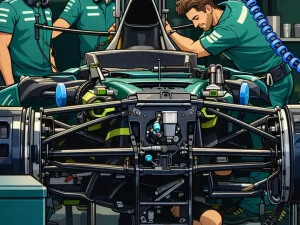
He spoke warmly about the factory effort behind the SF-26 and the mechanics’ contribution in the garage, pointing to reliable performance and clean pit work as the foundation of Ferrari’s campaign so far. It wasn’t a boast about outright pace — he even acknowledged Ferrari appears to be giving away power to Mercedes — but a nod to a different kind of advantage: fewer self-inflicted wounds.
And that’s where this gets strategically interesting. If Mercedes is indeed edging closer to an Energy Store or MGU-K penalty scenario, Ferrari doesn’t need to beat it everywhere to stay in touch. It needs to keep taking points, keep finishing, and be positioned to capitalise on the weekends when a rival’s plan collapses under the weight of component limits.
Hamilton put it plainly: Ferrari’s job is to “hold on to this, maximising the points,” even on days when winning isn’t realistic.
That approach matters because the championship picture still has shape despite the summer grind. Hamilton’s Silverstone podium leaves him 32 points behind Antonelli, who remains on top of the standings. But the British Grand Prix also offered a glimpse of how quickly a front-runner’s afternoon can go sideways: Antonelli picked up damage that forced two extra pit stops, recovered to ninth on the road, then slipped out of the points altogether after a five-second penalty.
For Ferrari — and for Hamilton personally — that’s the opening to keep leaning on. Not through talk of “momentum” or any of the usual paddock wallpaper, but by doing the dull, hard stuff: turning good days into solid points and bad days into something survivable.
For Mercedes, the real tension is that reliability doesn’t just cost you once. It costs you twice. First, you lose the result when the car stops. Then you risk paying again later if the fix requires additional power unit elements beyond the allocation. That second hit is the killer because it arrives on a weekend that might otherwise have been straightforward — and it tends to land at the worst possible time, when everyone’s chasing the same last few tenths and track position becomes gold dust.
Hamilton’s comments won’t have been welcomed in Brackley or Brixworth, but they’ll have been heard. Because when a driver of his experience starts publicly doing the maths on “at some point there must be a penalty,” it’s rarely idle chatter. It’s usually the sound of a championship being reframed — away from pure speed and towards who can get to the chequered flag without reaching for a fourth box on the parts sheet.