
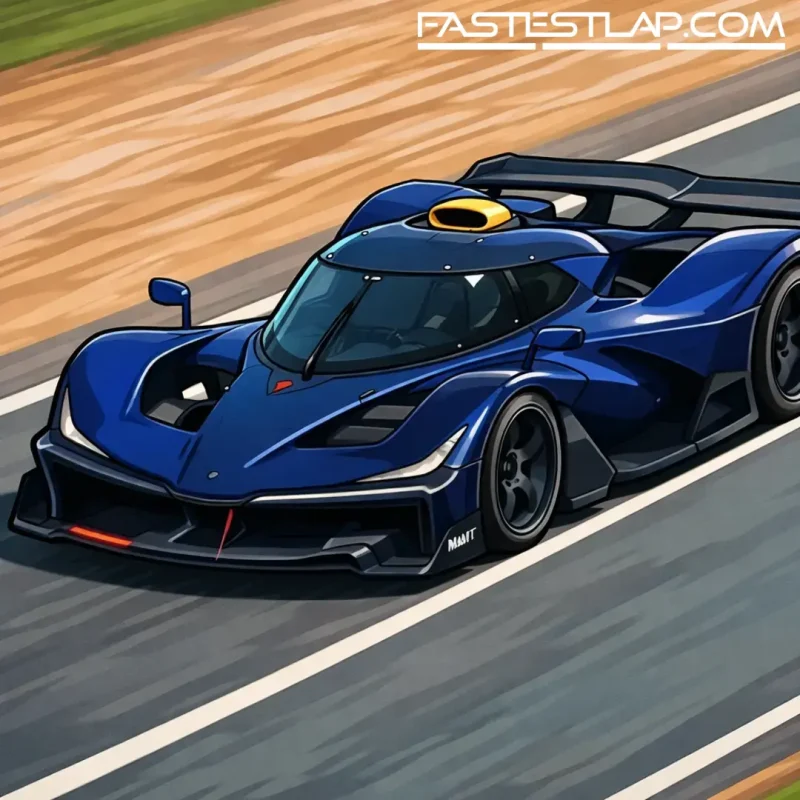
Red Bull is turning Goodwood into something close to a rolling museum of its own mythology this weekend — but the real point of interest isn’t an old title-winner on demonstration tyres. It’s the RB17: a track-only hypercar that’s been gestating for more than five years and will finally make its public debut at the Festival of Speed.
The headline hook is obvious. This is the car Adrian Newey penned under the Red Bull Advanced Technologies banner, free of racing regulations and built around the sort of old-school powerplant modern motorsport has almost made taboo: a naturally aspirated Cosworth V10 spinning to 15,000rpm. Red Bull has also confirmed Newey will drive it up the hillclimb himself, with Isack Hadjar and Yuki Tsunoda also taking turns behind the wheel.
Even without the paddock gossip that inevitably follows anything with Newey’s fingerprints on it, that driver line-up tells you what Red Bull wants from this weekend. It’s not just a static unveil for customers; it’s theatre — and credibility. Goodwood’s crowd is savvy, and the hill can expose a concept car masquerading as a finished product. Red Bull is plainly confident enough to let the RB17 speak in public.
The RB17 name carries its own wink to insiders: it’s lifted from the Formula 1 chassis designation Red Bull Racing never used in 2021, when it rolled out the RB16B instead and watched Max Verstappen take his first world championship. In typical Red Bull fashion, even the badge is a narrative thread.
But the bigger story is how aggressively Red Bull is positioning the RB17 as an engineering statement rather than a mere lifestyle accessory. There will be just 50 cars built. The quoted numbers are deliberately provocative — under 900kg, more than 1200bhp, and a target top speed beyond 350kph — and they’re framed with the kind of language F1 teams reserve for their own machinery: “Formula 1-inspired levels of performance,” “without the restrictions of racing rules”.
That last part is the giveaway. For all the romance of a V10 and the promise of outrageous pace, the RB17 is also a glimpse into how Red Bull sees its broader technical identity in 2026. This isn’t just the race team showing off. It’s “Red Bull Engineering” as a brand — a message that what happens at Milton Keynes can be productised and sold, at stratospheric price points, without needing a grand prix entry list as the only proof of competence.
Laurent Mekies, now installed as Red Bull Racing team principal and CEO, is leaning hard into that idea. Goodwood, he said, is “the perfect place to celebrate what Red Bull Engineering is all about,” tying together “heritage”, “innovation” and “the incredible talent of the people behind our projects.” It’s corporate language, sure, but there’s a sharper edge underneath: Red Bull wants to be seen as a serious engineering house with a portfolio — not simply a racing team with a drinks logo.
Rob Gray, technical director at Red Bull Advanced Technologies, went further in spelling out the intent. The “ambition”, he said, was to deliver performance “rarely seen outside Formula 1” in a customer track car — a task that required solving “countless challenges across design, engineering, validation, testing and manufacture.” He also described Goodwood as a “milestone” rather than a finish line, with development continuing as the programme explores its “full performance potential”.
In other words: don’t expect this weekend to be the end of the story. Red Bull is framing the RB17 as a living project, not a one-off spectacle — and, crucially, as something that can take the scrutiny of real running in front of fans. That matters because track-only hypercars live and die by reputation. They don’t have racing series results to hide behind, and their owners tend to be the kind who will notice if the product feels like a glossy promise rather than a coherent machine.
There’s also an unavoidable subtext. Newey has since left for Aston Martin, but the RB17 has continued towards launch regardless. It’s a reminder that his influence still sits across Red Bull’s wider ecosystem — and that the organisation is determined to show it can take a Newey-originated concept through to a finished, functioning car even after he’s gone. Goodwood, with Newey driving, is a neat way to close that circle publicly.
Around the RB17 debut, Red Bull is also bringing selected “memorable liveries” from across its F1 history for display, which will help set the scene: nostalgia on one side, the future on the other, all wrapped into a single weekend that’s designed to keep the team’s story bigger than the current championship table.
Ultimately, the RB17’s hillclimb run will be the moment everyone remembers — or rewinds. If it looks composed and purposeful, it’ll land as a genuine engineering flex. If it doesn’t, it’ll still be a spectacle, but the myth-making becomes harder. Red Bull doesn’t strike you as a company that turns up to Goodwood hoping for the best.









