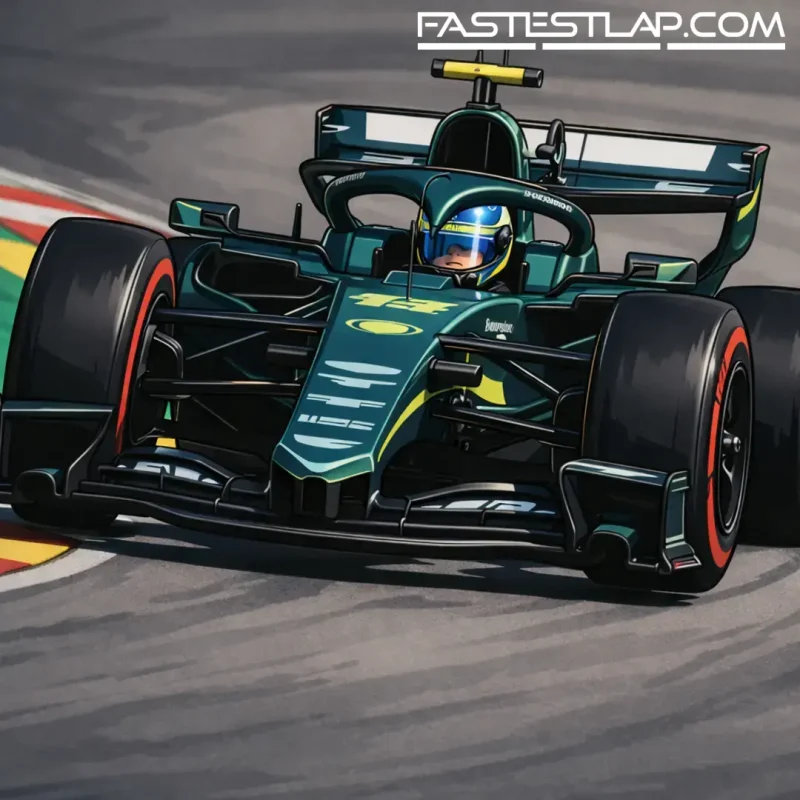
Aston Martin’s summer has started to feel like a holding pattern: grit your teeth through Spa, get to Budapest, and hope the car you unload in Hungary is finally the one the factory has been promising since the new rules landed.
That, at least, is how Pedro de la Rosa is pitching it. The team’s spokesperson has been careful not to hang a lap-time number on what’s coming, but he’s been bullish about the intent: a fundamentally stronger AMR26 that gives Fernando Alonso and Lance Stroll a platform they can actually lean on — predictable, faster, and, crucially, capable of mixing it in the midfield rather than simply surviving races.
The key point is Aston isn’t treating this as another incremental Friday-night bolt-on. Adrian Newey has already outlined that Budapest is where a “large step” package arrives, shaped by a philosophy he and chief technical officer Enrico Cardile have adopted since getting their feet under the table: stop drip-feeding small changes and instead land a comprehensive overhaul when the pieces are ready to work together.
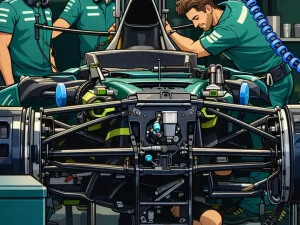
It’s also not just an aero refresh. Aston has had to re-homologate the forward chassis as part of a weight-saving programme, and the upgrade includes a new nose, “substantially revised” aerodynamic surfaces, and a revised rear suspension. That’s a lot of the car’s behaviour being re-written in one go — not the kind of update you bring unless you’re admitting the existing baseline isn’t worth polishing.
De la Rosa, speaking ahead of the Budapest rollout, kept coming back to the same theme: deliver first, talk later. Aston Martin is acutely aware of how far it’s fallen.
“It has to help the drivers fight, basically… fight, enjoy themselves, have a more predictable platform, faster, and eventually more competitive,” he said. “So we should never put up a target on how quick… because there are many unknowns yet, and we should be very cautious, because there’s no point in actually saying something; we just have to deliver.
“We are at a point now of being last; we just have to deliver. Our fans deserve that.”
That bluntness matters because it’s a different posture to the polished optimism Aston has sometimes leaned on during this project. After Barcelona, Mike Krack apologised to fans for the team’s lack of competitiveness — an unusually public acknowledgement that the gap wasn’t a one-off, it was structural.
De la Rosa insists the message now is realistic excitement: the package should move them forward, but it’s not a magic wand.
“We are excited, but we are also realistic,” he said. “The message is we are working flat out… we will improve, but there will still be a lot of other areas that will still need to improve further.
“However, we will be in a better position than we are right now… Let’s not forget that Formula 1 is difficult. We’re coming from very far away, and it will take time.”
There’s another layer here, and it’s the one that will interest anyone watching Aston’s long game into 2026 and beyond: this upgrade is being presented as a proof point for the way the team now operates, not just what it’s bolting to the car.
In Newey’s own assessment, parts of Aston’s internal structure simply weren’t working — a hangover, in his telling, from the organisation’s long evolution through different identities. His fix isn’t glamorous in the way a new floor edge is glamorous, but it’s arguably more important: bringing manufacturing and production back in-house to tighten the feedback loop and stop performance being lost in translation between departments, suppliers, and timelines.
Newey has talked about more components now being produced internally — including the gearbox casing and floor production — for cost control, yes, but more for agility and quality control. It’s a familiar argument in modern F1: you can’t iterate quickly enough if you’re waiting on somebody else’s schedule, and you can’t understand your own problems if too much of the process happens outside your walls.
De la Rosa’s view is that the painful bit is largely done.
“We’ve done most of the hard work,” he said. “Right now, we just have to stick together, keep united, keep working under the great leadership of Adrian… It’s never going to be easy.”
That’s where Budapest becomes symbolic. If the AMR26 steps forward in the way Aston believes it can, it won’t just change Alonso’s Sundays — it validates the heavy infrastructure spend Lawrence Stroll has poured into the project over the last five years. The team now has the tools it’s been craving: modern facilities, upgraded R&D capability, a state-of-the-art simulator, and a wind tunnel. The claim is that the missing pieces are no longer physical, they’re procedural — and those procedures are now being aligned by people who’ve built title-winning operations before.
“I think we are at the point where we will see in the next few months our full potential,” de la Rosa said. “What is good now, in six months’ time is completely obsolete technology… but Lawrence always says you need the tools… and we can say now proudly that we finally have all these in place.
“It might not look like it, looking at where we are at the moment on the grid, but it’s really exciting times.”
For Alonso, it can’t come soon enough. The veteran doesn’t need selling on “process” — he needs a car that lets him race. For Stroll, the pressure is different but no less real: when a team invests this heavily, the on-track product eventually has to catch up to the brochure.
Aston Martin is trying to turn Budapest into the pivot point. Whether it becomes that, or just another promise deferred to the next update, will be written in the first few laps when the upgraded AMR26 is finally asked the only question that matters in F1: can you actually fight?