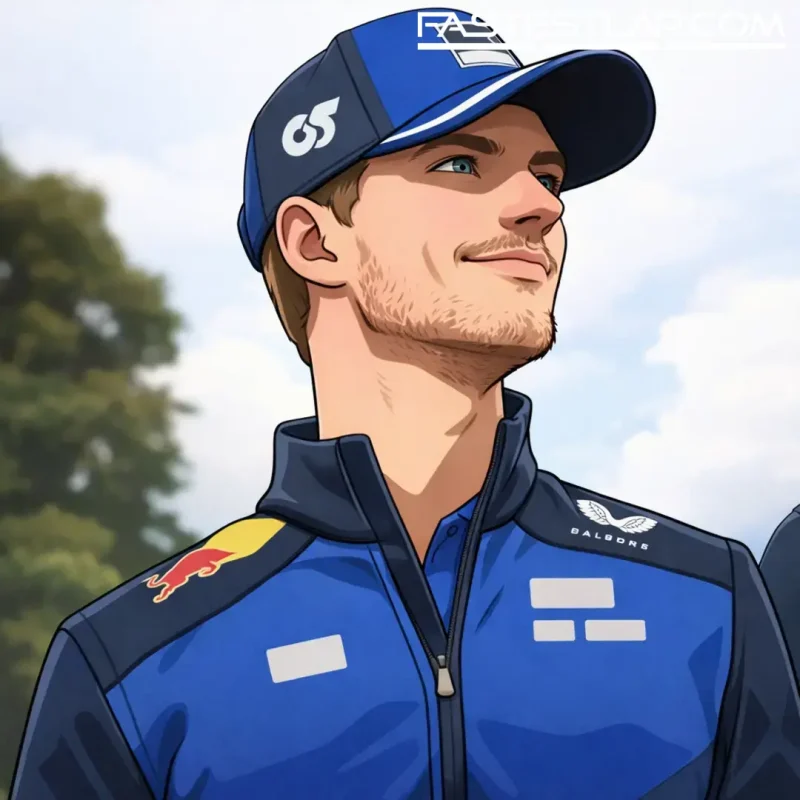
Jenson Button isn’t buying the romantic notion that Max Verstappen might step away from Formula 1 for a year, clear his head, then return refreshed. In Button’s view, Verstappen simply isn’t wired that way: if he checks out mentally, he won’t be back for an encore.
The context matters. Verstappen has never behaved like a driver chasing statistical immortality at all costs. Even as a four-time world champion, he’s repeatedly framed F1 as something he’ll do only while it still feels like racing — not an obligation to tick off records. And in 2026, with regulations that have left him openly unimpressed, that line has started to sound less like a throwaway philosophy and more like an actual exit strategy.
Verstappen’s complaints haven’t been subtle. The new, battery-dominant era has prompted him to mock what he’s driving as “Formula E on steroids”, liken it to “Mario Kart”, and take aim at the now-familiar “mushroom” boost. That isn’t the language of someone merely blowing off steam after a rough weekend; it’s the rhetoric of a driver who feels the sport has moved away from what he came for in the first place.
He’s still contractually tied to Red Bull through the end of 2028. But Verstappen has also been blunt about the limits of paper. If he’s not enjoying himself, he’d rather be somewhere else — and crucially, he has already started building that “somewhere else”. He’s been dipping into GT3 racing and, last weekend, took part in the qualifier events for the Nürburgring 24 Hours. He’ll return to the Nordschleife in May for the endurance race itself, a choice that reads less like a hobby and more like a reminder that he can race hard without the F1 circus attached.
At Suzuka, Verstappen didn’t try particularly hard to calm the noise. Asked what he was thinking about, he said: “Life here.” A day later, he went further, explaining he’s weighing up whether it’s “worth it” — or whether he’d rather be at home with family and friends if the sport no longer gives him anything back. It’s not a complaint about one car, one season, or one political headache. It’s a bigger question: what’s the point if the fun’s gone?
That’s where the sabbatical theory has come in — the classic F1 pause, like Fernando Alonso or Michael Schumacher once took. Button, though, sees Verstappen as far more binary.
“Personally, it doesn’t feel like he’s the kind of guy who takes a sabbatical,” Button said on Sky F1. “He’s either racing or he’s not.
“If he wants to stop and go do something else, that’s fun as well. I think this will be his last ‘career’ in F1. I don’t think he’ll take a year out and come back. I don’t think that’s the Max I’ve come to know.”
It’s a telling read from someone who knows what it looks like when a champion’s internal motivations shift. Drivers who return from sabbaticals tend to leave a door open in the way they talk — a sense that F1 is unfinished business. Verstappen, by contrast, has increasingly spoken as if F1 is just one chapter in a broader racing life.
Button also pointed to a development that has added sharpness to the speculation: Verstappen’s long-time race engineer Gianpiero Lambiase is set to move to McLaren no later than 2028. On its own, personnel movement is hardly unusual. But in Verstappen’s world, Lambiase has been more than a race engineer — he’s been the voice in the ear through titles, controversy, and all the pressure that comes with being the sport’s benchmark.
Button found the timing jarring given Verstappen’s previous stance.
“Only a few weeks before it was announced that Lambiase was going to McLaren, Max came out and said ‘I can’t ever imagine racing with him by my side’,” Button noted. “But it’s 2028… We’ll see.”
If you’re looking for tea leaves, that’s one of the clearer ones. The Lambiase news doesn’t prove Verstappen is leaving — but it does show Red Bull is planning for a future in which the most successful driver-engineer pairing of the era isn’t guaranteed to stay intact. In a paddock where everybody talks about “stability” until the moment it costs them, these decisions rarely happen in isolation.
Button, for his part, sounded less concerned about where Verstappen might go — Mercedes has been floated in the wider rumour mill — and more interested in what Verstappen wants from the sport at all. The key detail, as Button framed it, is that Verstappen is suddenly a superstar not papering over a car that isn’t doing what it used to.
“Max is always going to be the centre of attention because he’s in a car, at the moment, that’s not performing,” Button said. “We’re used to him being at the front, and he’s not.”
That, ultimately, is the combustible mix: a champion who doesn’t need F1 for validation, a regulation set he’s publicly derided, alternative racing outlets that genuinely excite him, and a Red Bull environment that — with Lambiase’s looming exit — looks less like a permanent home than it did.
A sabbatical would imply unfinished business. Button’s point is that Verstappen doesn’t really do “unfinished.” If he decides the 2026 version of Formula 1 isn’t worth the compromise, he may not pause the story — he may just end it.