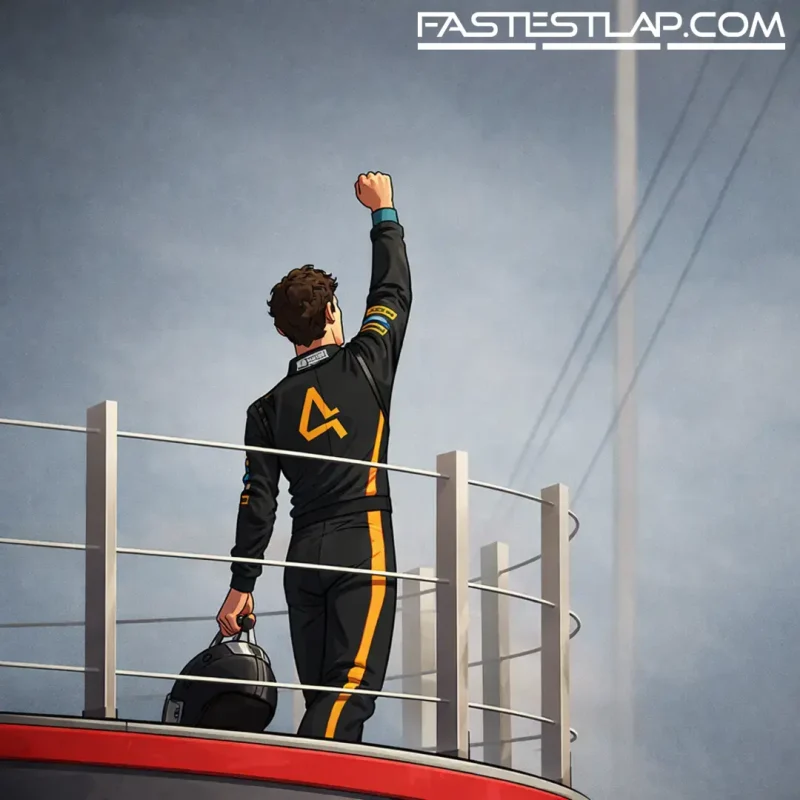
Lando Norris’ 2025 title already did most of the talking, but the sport’s wider establishment has now added its own seal of approval. At the Laureus World Sports Awards, Norris was named Breakthrough of the Year — an honour that lands neatly alongside the biggest piece of silverware of his career, the world championship trophy he edged out in a finale that still feels raw if you were on either side of the McLaren garage.
Breakthrough is an interesting word for a driver who’s been in Formula 1 long enough to have learned how quickly the paddock moves on. Yet that’s precisely why the award fits. Norris didn’t simply win a championship; he survived one — through an internal fight that became the story of the season, a late Red Bull resurgence that turned the run-in into trench warfare, and the kind of points-swing drama that only F1 can conjure when pressure, penalties and performance collide.
For long stretches last year it looked like Oscar Piastri had the upper hand as McLaren’s intra-team duel sharpened. But Norris kept doing the unglamorous part: banking results, leaning on the team when he had momentum, and refusing to let a mid-season narrative harden into a season-long verdict. When he finally hauled himself past Piastri, the reward wasn’t daylight — it was Max Verstappen in the mirrors, with Red Bull finding form late on and the championship suddenly turning from a McLaren civil war into a three-way knife fight.
Then came Las Vegas, and the sort of weekend that leaves everyone staring at calculators. Both McLaren drivers were disqualified, Verstappen drew level with Piastri, and Norris’ margin — once comfortable enough to breathe — started evaporating. Verstappen followed up with a second straight win in Qatar, and Norris arrived at the finale just 12 points clear. That’s not a cushion; that’s a lead you can feel in your stomach.
Abu Dhabi did what Abu Dhabi often does and served as a pressure cooker with immaculate lighting. Norris crossed the line third while Verstappen completed a third consecutive victory. But Norris had built just enough earlier in the year — and resisted just enough late in it — to take the championship by two points. It was the sort of ending that changes how a driver is discussed, because it’s no longer about potential, or promise, or “when it clicks”. It clicked, with the whole world watching.
Receiving the Laureus trophy from cyclist Chris Hoy, Norris sounded like someone still processing how quickly a career can flip from pursuit to possession.
“Thank you very much. Oh, got a little bit of weight,” he said, before paying tribute to Hoy and the Laureus Academy. Norris spoke about the significance of joining the list of nominees and winners he grew up watching, and about how rare it is to “achieve their dream”. He thanked McLaren and his family, and joked about where the prize would go: “It’s a beautiful award, I put it next to my world championship trophy, and I’ll smile every day.”
The more telling line, though, was one any F1 lifer will nod along with: the insistence that a title is never an individual act. “Winning the world championship is something I dreamed about since I was young, so to win my first in 2025 is pretty special,” Norris said. “It’s far from being an individual achievement. Without my team, who were also nominated for a Laureus Team of the Year award, I wouldn’t be where I am today.”
That’s not just polite awards-night etiquette. It reflects the reality of how Norris won the championship: by operating in the narrow space where a driver’s brilliance still needs the machine, the pitwall and the organisation behind it to land the blows that count. McLaren didn’t just deliver a quick car; it navigated a season where its two drivers were legitimate title threats and still came out with the sport’s biggest prize. The Las Vegas double DSQ shows how fragile that path can be — one wrong step and the whole year tilts.
Elsewhere at the awards, Carlos Alcaraz was named Sportsman of the Year, with Aryna Sabalenka taking Sportswoman of the Year. Paris St-Germain won Team of the Year.
For Norris, the timing is neat as F1 heads deeper into 2026 with a champion who’s no longer chasing validation. Breakthrough awards can sometimes feel like they arrive a season too late, once the story is already familiar. In this case, it’s landed at exactly the moment Norris’ reputation has shifted from “future” to “fact” — and when the paddock is starting to look at him differently, too.