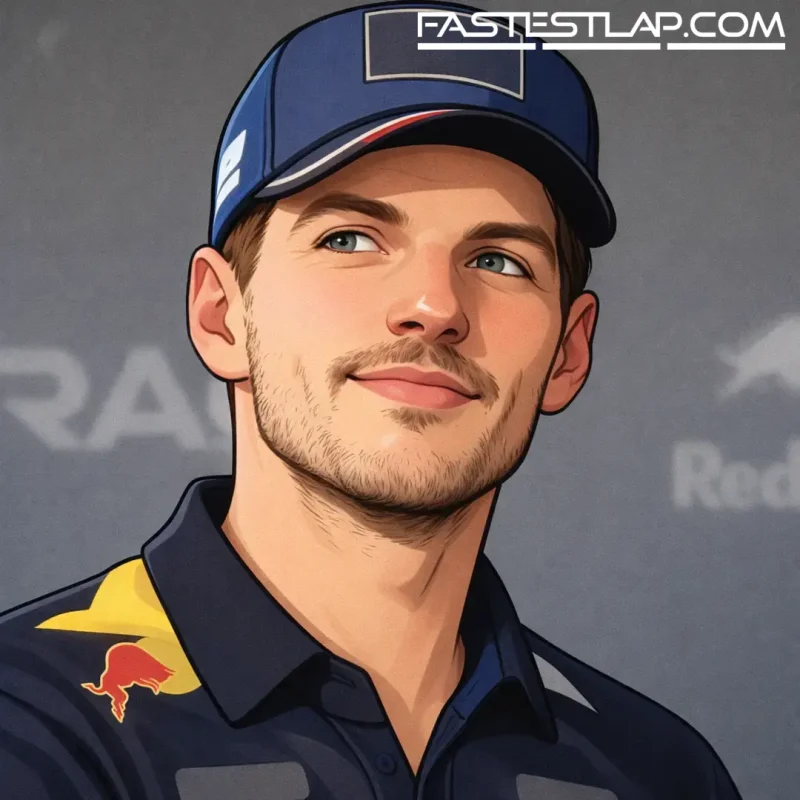
Max Verstappen had a clean chance at Spa to put a lid on the paddock noise. He didn’t take it.
Twelve months ago in Hungary, he cut through a similar fog with two blunt sentences — “it was always quite clear that I was staying” — and the story died on the spot. This time, with the Belgian Grand Prix weekend underway and fresh talk linking him to McLaren, Verstappen chose the other path: keep it vague, keep it moving, and leave everyone else to fill in the blanks.
Asked directly by Globo TV’s Mariana Becker whether he wants to remain at Red Bull, Verstappen didn’t bite.
“I don’t want to go here and say yes and no, and this and that, about my future,” he said. “I’ve said already many times that if there was something new, I would say it myself. Thank you.”
For a driver who’s made a career out of blunt clarity, it landed as a deliberate non-answer. And in this sport, deliberate non-answers usually mean one thing: there’s an incentive to preserve optionality.
That theme ran through the messaging from his side of the table in the 24 hours before Verstappen spoke. Manager Raymond Vermeulen told Austria’s OE24 that Verstappen “wants to see things through with Red Bull”, stressing the existence of a contract through 2028 — but also stressing, pointedly, that having an escape clause doesn’t mean it’ll be used. It was reassuring, on paper. It also carefully avoided the one sentence that would actually stop the carousel: Max will be a Red Bull driver next year.
The timing matters. Red Bull is only a few weeks removed from the turbulence of Christian Horner’s dismissal and a broader reset in how the team is being steered. Last year, Verstappen’s public commitment came when Red Bull had offered a clear pressure-release valve: remove the figure at the centre of the storm, restore internal calm, and sell a narrative of stability. In 2026, there isn’t an obvious “fix it with one move” solution to point at. The on-track picture is described as sporadic, and the political weather around the team sounds no calmer — including shareholders reportedly unimpressed by the lack of certainty.
Then there’s the contract mechanism hanging over all of it. Verstappen’s escape clause is understood to become actionable after next weekend’s Hungarian Grand Prix, for the first time since he became a world champion, and that turns every carefully chosen word into part of a negotiation — whether it’s a negotiation with Red Bull, with a rival, or simply with time.
This is where the paddock tells are more revealing than any quote. If Verstappen truly wanted the speculation to end, it would end. He has the stature to do it in one line, and Red Bull would be thrilled to amplify it. Vermeulen could do it too, just as easily, without the awkwardness of a driver batting away questions at a race weekend. Instead, what you’re getting is controlled ambiguity: enough positivity to keep Red Bull from panicking publicly, enough wiggle room to avoid being boxed in later.
Why? Take your pick — and it may be more than one.
There’s the classic leverage play: keep your team “on its toes” and make sure you’re not treated as a fixed asset at a moment when relationships are said to be strained. There’s the financial angle, even if it’s been suggested Verstappen previously turned down an $8 million offer to remove the escape clause from his deal. And then there’s the obvious one, the one the paddock always circles back to because it explains the careful phrasing: there are conversations elsewhere that you don’t want to jeopardise with a definitive soundbite.
McLaren is the centre of the current storm because the rumour isn’t just “Verstappen is unhappy”. It’s “Verstappen could land in a car that doesn’t have an obvious vacancy.” That automatically puts Oscar Piastri in the firing line, regardless of what Piastri does or doesn’t deserve.
Piastri, speaking on Thursday, didn’t exactly pour water on the idea that Verstappen is at least looking around.
“Clearly, Max is feeling that maybe he’s not in a great position at the moment or exploring options,” he said. “It was the same thing last year with him and Mercedes, so it’s nothing new, but I’m very happy with where I’m at, where things are at and how it’s going.”
Piastri also went out of his way to underline how McLaren leadership has handled the background noise.
“For me, I’m very comfortable with where I am and where I sit,” he said. “Zak and Andrea and the whole team have been great through all that. Very reassuring — and I’ve been the same to them!”
It read as calm, professional, and — crucially — not entirely in his control. Because the uncomfortable truth for any driver is that reassurance from management only lasts until the moment the opportunity cost changes. If McLaren’s senior decision-makers decide Verstappen is worth the disruption, the optics, and the bill that comes with shifting an incumbent before their contract is up, the rest becomes detail.
That’s why Zak Brown’s earlier attempt at a shutdown at Silverstone still doesn’t fully close the door. Asked what McLaren could offer Verstappen that Red Bull couldn’t, Brown said: “I haven’t really thought about that because I’ve got two drivers in the seats. So, what I couldn’t offer him was a seat in my race car.”
It was a strong line — but framed in the past tense, with just enough breathing room for the situation to evolve. In F1, that’s not an accident. It’s simply how people speak when they don’t want to be trapped by their own quote two weeks later.
So Spa becomes less about what Verstappen said and more about what he chose not to say. In a year where his first realistic contract break-point is approaching, and with Red Bull in a transitional moment both politically and competitively, he looks like a driver keeping every lever available.
If nothing else, Verstappen’s posture tells you this much: he doesn’t feel the need to protect Red Bull from the noise anymore. And when the sport’s most decisive operator starts leaving doors ajar, everyone in the pit lane starts checking which way the hinges swing.