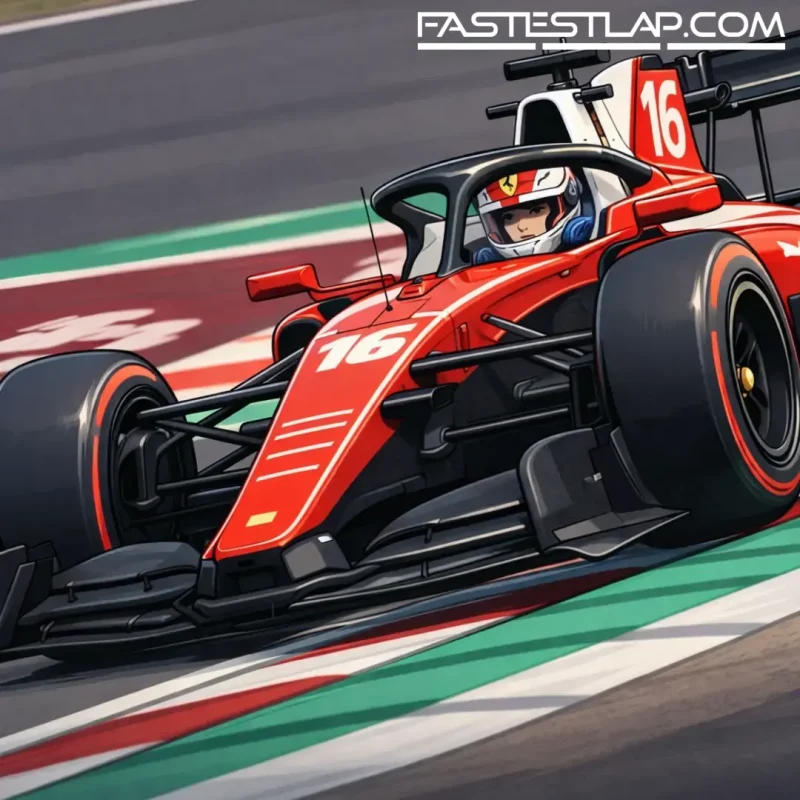
Ferrari’s “macarena” rear wing is back in the wild — and the timing is telling.
A fan-shot clip from Monza on Wednesday shows the SF-26 circulating on a filming day with its much-discussed rotating rear wing fitted, the first clear sighting of the concept since the team quietly mothballed it after a messy Shanghai experiment. In the video, the wing returns to its normal position as the active aero is deactivated on the main straight, the giveaway that Ferrari’s not simply running a conventional DRS-style arrangement.
That in itself wouldn’t be earth-shattering — teams try plenty of bits in private — but Ferrari choosing to revisit this particular idea during F1’s April lull points to a team still wrestling with where it wants its 2026 car’s performance to come from. And it comes with Miami looming as the next hard deadline.
Ferrari first flirted with the rotating wing in Bahrain pre-season testing, where it was hard to miss and even harder to ignore given how aggressively it rethinks the usual active aero “open/close” logic. But when the season began in Australia, it wasn’t on the car. The message then was caution: new regs, new aero philosophy, no need to complicate the opening weekend.
China changed that. Ferrari bolted the device back on for practice in Shanghai, letting both Charles Leclerc and Lewis Hamilton run it, before Hamilton’s FP1 spin put a spotlight on a concept that was always going to be high profile the moment it appeared in public. Whether the wing was a root cause, a contributing factor, or simply the most visible new thing on a car that bit back is almost beside the point; Ferrari’s reaction mattered more. By the rest of the weekend it had reverted to a more conventional DRS-style mechanism.
Hamilton didn’t dress it up afterwards. He described using it on a race weekend as “maybe a little bit premature”, with development work still required. In a paddock where drivers tend to be diplomatically vague about experimental parts, that was a fairly clear flare: interesting idea, not yet race-ready.
So why bring it back now?
Because the value of a filming day in 2026 isn’t the glossy partner content — not really. It’s the chance to take something complicated, run it on a real track, and interrogate the behaviour without the noise and time pressure of a grand prix weekend. Under the rules, teams get two filming days per season, each capped at 200km, and everyone knows they’re often treated as stealth test sessions. If you want to understand a mechanism that has potential “transition” drawbacks — including that brief sail-like effect as it rotates open and shut, and the fact it takes longer than a conventional DRS-style solution — you need mileage. Even a restricted day can be useful for correlation and basic operational confidence.
It also fits neatly with Ferrari’s broader Miami build-up. The Scuderia is expected to bring a significant upgrade to Florida, with Fred Vasseur hinting it could arrive with “a package and a half” after updates originally planned for the since-cancelled Bahrain Grand Prix were pushed back. When teams talk like that, it usually means a bundle of changes rather than one hero part — floor, bodywork, aero balance, perhaps suspension set-up options — the kind of stuff that works best if the car’s overall platform is in a stable place.
And that’s where the rotating wing becomes more than a curiosity. Active aero on these 2026 cars is a system, not a bolt-on party trick. If Ferrari wants to unlock performance via a more ambitious rear-wing solution, it has to behave predictably with the rest of the aero map and it has to be robust operationally — no hesitation, no odd transitional moments, no surprises for the driver when they hit the button. It’s one thing to chase peak lap time in ideal conditions; it’s another to live with it through wind shifts, dirty air, and the small compromises that define race weekends.
There’s also an internal dynamic here that’s hard to ignore. Ferrari’s got Leclerc, who knows the team’s engineering language inside out, and Hamilton, who has spent a career leaning on stability, repeatability, and raceable balance. When a new mechanism arrives and one driver calls it premature after the first public wobble, that’s not drama — it’s information. Ferrari will have to decide whether it wants to keep pushing the ceiling with this concept or bank simpler, more dependable gains elsewhere while it’s still finding its feet under the new ruleset.
Wednesday’s Monza running doesn’t confirm the rotating wing will reappear in Miami. Filming days are often used to try parts the team has no intention of racing immediately. But it does confirm Ferrari hasn’t abandoned the idea, despite the Shanghai retreat. It’s still on the table — and that suggests the upside is big enough to justify the development pain.
Ferrari also posted its own social clip of Leclerc in the garage preparing to head out, though it hasn’t clarified who else is present at Monza. Hamilton, meanwhile, completed an artificial wet tyre test with the SF-26 at Fiorano earlier this month, so his April hasn’t exactly been quiet even with the calendar pause.
Elsewhere, Red Bull is understood to be running on Wednesday too, with Max Verstappen spotted driving the RB22 at Silverstone — another reminder that this “break” in the schedule is often where the next phase of the season is quietly decided.
For Ferrari, the rotating rear wing remains a bet: potentially a clever interpretation that rivals sniffed at but avoided due to the compromises, and potentially a distraction if it can’t be made clean and consistent. Monza’s filming day mileage won’t answer all of that. But it’s a sign Ferrari’s still willing to roll the dice — and that Miami may arrive with more than just new bodywork.