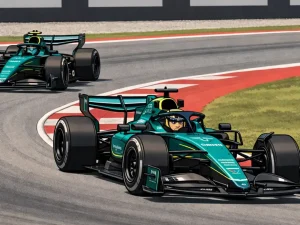
Toto Wolff didn’t bother dressing it up in Miami. Mercedes might have left town with another win – and another pole in Kimi Antonelli’s rapidly growing collection – but the team boss was far more interested in what keeps happening in the first 150 metres.
“We all know it’s just not good enough,” Wolff said, bluntly, after watching Antonelli lose ground off the line yet again. For a front-running outfit that’s doing the hard part – extracting one-lap pace and putting its driver at the front three grands prix in a row – Mercedes’ inability to routinely convert pole into Turn 1 control has started to look less like a quirk and more like an avoidable handicap.
Antonelli still won. Again. But it’s the sort of victory that masks a structural problem until it doesn’t.
In the new 2026 engine era, the launch phase has become a far bigger differentiator than most expected, largely because F1’s decision to remove the MGU-H has changed the feel and management of turbo response. That’s fed into a pecking order off the line that has been fairly consistent: Ferrari has been the benchmark, and the paddock has been whispering about its advantage in getting the turbo into the right window quickly – the sort of detail that can decide whether you’re defending or reacting before you’ve even reached the braking zone.
The four-week pause before Miami appears to have helped some of Ferrari’s rivals claw back ground in that department. Wolff hinted that McLaren and “others” have moved closer. Mercedes, though, arrived in Florida without major car upgrades and found itself, once again, glancing in the mirrors at lights-out.
Wolff framed it as a team failure rather than a driver one – which is telling, given Antonelli is a rookie in experience if not in results. “I think today and yesterday was a team mistake,” he said. “We’re not doing a good enough job in giving them a tool in their hands and we are the only ones who… don’t get that right now for a few races.”
That “only ones” line is the jab. This isn’t about losing a car length to Ferrari once in a while; it’s about being the outlier at the front. And in a season Wolff describes as too tight for anyone to “cruise into the sunset”, those giveaways are the sort that can turn a controlled Sunday into a messy one quickly – especially if you’re forced to burn tyres and strategy just to restore the order you’d already earned on Saturday.
Antonelli wasn’t hiding from his share of it either. Despite taking pole for the third consecutive grand prix, he’s yet to be leading when the field funnels into Turn 1. Miami, by his own admission, was an improvement – but only in the way a small fire is preferable to a big one.
“Today, to be fair, was not as bad,” Antonelli said after the race. “I think I lost two places, Sprint I lost six, so a little bit better. But still, no, it’s not acceptable.”
That’s the other part of Mercedes’ headache: it isn’t purely mechanical. Starts now sit right on the seam between hardware, software and human feel, and Antonelli talked openly about inconsistency in his clutch drop and a lack of confidence repeating the same execution every time.
“I still don’t have that confidence, being consistent with that,” he admitted. “I still have a bit of uncertainty… yesterday, for example, in the Sprint, procedure-wise it was good, but just the grip level that we thought there was, was just not there.”
That comment is a window into how these starts are being won and lost in 2026. It’s not simply reaction time or bravery; it’s the accuracy of the model. If the team’s expectation of grip is off by a fraction, the driver is effectively guessing at the moment where the car is most vulnerable. When you’re launching alongside a Ferrari that’s routinely nailing the initial phase, you don’t get a second bite.
Antonelli said he handled the frustration better on Sunday than he did in the Sprint – “yesterday I was very frustrated and today I just kept it a bit cool” – which will please Mercedes as much as the trophy did. There’s a psychological tax to repeatedly losing the first exchange even when you’ve done the work to start from pole, and the easiest trap for a young driver is to chase the perfect start so hard that you create the next mistake.
What keeps Mercedes calm, for now, is the scoreboard. Antonelli has converted every grand prix pole into a win, and he leads the drivers’ championship on 100 points, 20 clear of George Russell. Charles Leclerc sits third, a further 21 points back. That’s a healthy margin at this stage, but the subtext of Wolff’s remarks is that Mercedes doesn’t think it can keep living like this – not with the field compressing and not with rivals who will punish any softness at the start.
Because eventually the recovery drive won’t be so clean. Eventually the car that jumps you off the line will also have the pace to stay there.
And if Mercedes wants this season to be remembered as the year Antonelli properly arrived, rather than the year he kept having to fix Turn 1 problems of his own team’s making, it can’t keep treating the launch as an inconvenience. It’s become a performance pillar.
Miami was another win. Wolff’s mood suggested it felt like a warning.